
Farmed fish
According to the United Nations, the total number of aquatic animals killed for human purposes (including both wild-caught/fisheries and factory-farmed/aquaculture), has increased over the decades, going from 19 million tonnes (live weight equivalent) in 1950, to an all-time record of over 185 million tonnes in 2022, the sale value estimated at a staggering USD 452 billion in 2022 (about AUD 700 billion). The numbers of aquatic animals are so enormous, they are only measured in tonnes.
The United Nations reports that the number of aquatic animals being factory-farmed has also only risen over time. In 2022, 94 million tonnes of aquatic animals were bred into underwater factory farms and killed, accounting for 51% of fish products produced - the farmgate value of which is USD 295 billion (about AUD 458 billion).
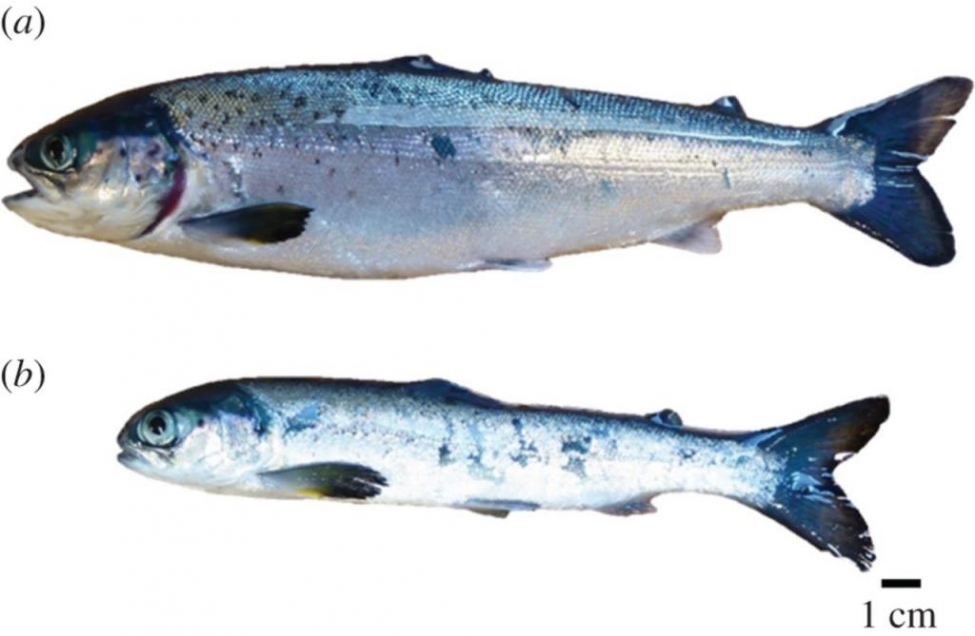 (a) Is a healthy Atlantic salmon (b) A growth-stunted 'drop out' salmon. Photo by Ole Folkedal
Fish raised in underwater fish farms have been observed to exhibit brain activity akin to that of humans under extreme stress and depression.
Research suggests stunted growth in farmed fish is a strong indication of their emotional state.
Breeding
Breeder fish, known as brood fish, have their eggs ('roe') and milt (containing sperm) collected in a hatchery.
Female fish are given hormone injections to induce ovulation.
Female fish are 'milked' or sliced open and their eggs are squeezed or scooped out from inside of them. Sperm is squeezed out of male fish to combine with the females' eggs.
Although anaesthesia is often used in the egg collection process, there is no legal requirement to do so. Anaesthesia is used not out of kindness but to inhibit a fish's natural response to exposure to oxygen, which is to thrash and struggle. As this impedes a workers ability to harvest eggs, they use anaesthesia to immobilise the fish.
Egg collection methods
The primary methods for collecting eggs from female fish are:
- Hand-stripping (also known as manual stripping or 'milking')
- Abdominal incision (also known as surgical removal or slitting)
Hand-stripping
Some female fish are hand-stripped or 'milked', a non-fatal process where female fish are first partially anaesthetised. A worker then removes the female fish from the water, towels her off, slaps her a few times, holds her on her side, and applies hand pressure to her abdomen, 'squeezing' or 'massaging' her, to force her to release her eggs into a bowl.
Surgical removal
Because the internal anatomy of fish varies, hand-stripping may be difficult in some species, like sturgeon and paddlefish. These fish will have their eggs 'surgically removed'. In other words, the worker slices these fish open. There are two primary methods of this: non-fatal and fatal.
The female fish is first anaesthetised. An antibiotic solution is applied to the abdomen. An incision is made along the midline of the abdomen, and the eggs are removed with a spoon. The incision is closed with a half-circle surgical needle and suture material. The incision area is treated with an antibiotic before the female fish is returned to the holding tank. A high level of dissolved oxygen is crucial for rapid recovery of the fish. Many female fish survive this process and are used for future breeding (and eventually killed).
A greater quantity of eggs can be obtained by killing the female fish. If the female fish is to be killed (or 'sacrificed', as the industry calls it), she is:
- held in a net and killed with a blow to the head;
- hung from a hook;
- her tail is cut off to bleed her, minimising the contamination of the eggs with blood;
- an incision is made in her abdomen starting at her vent (a vent is the external opening on a fish that serves as the anus and a genital and urinary pore. On a female fish, it's where her eggs are released during ovulation); and
- a bowl is placed under her vent, directly below the incision. The eggs flow quickly from her abdomen, pulled by the force of gravity. Not all the eggs will be free in the abdomen; some remain attached to the folds of the ovaries. These eggs are removed by hand and placed in separate bowls.
*For the production of caviar, the process of egg collection is much the same. The main difference is that in caviar, the eggs aren't fertilised.
The collection of milt (containing sperm)
Male fish are captured, removed from the water, wiped off, and held belly down over the bowl containing the eggs. The abdomen of the male fish is 'massaged' or 'squeezed' to force him to release his milt (containing sperm) into the bowl containing the eggs to fertilise them. Many male fish survive this process and are used for future breeding (and eventually killed).
The eggs are incubated until the fry (baby fish) are actively feeding, and then they are moved to rearing tanks or cages.
Hatchery
Farmed fish are bred indoors in hatcheries. As fish grow, they are moved to various tanks inside the hatchery facility. As an example, farmed salmon spend 10 to 16 months of their lives in on-land tanks.
Whether fish are a freshwater or saltwater breed largely dictates the way in which they are farmed.
Cages and tanks
Freshwater fish, such as barramundi, will spend their entire lives - years - in either indoor tanks or outdoor pens.
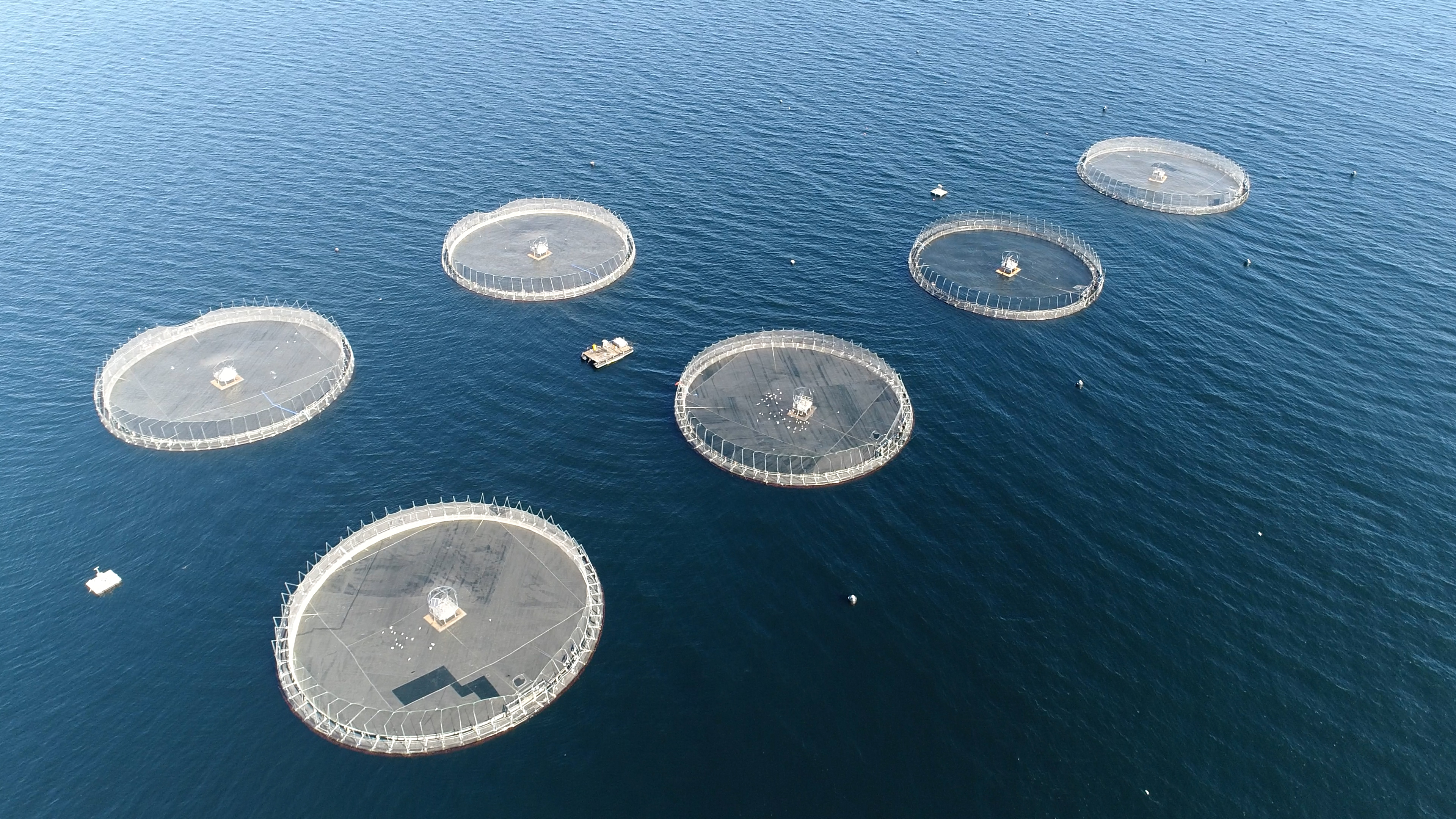
Other breeds, like salmon, are pushed through pipes and into tanks which take them out to caged sections of the sea where they will spend another 14 to 18 months before they are killed. In the underwater cages, salmon are crammed in with thousands of others, unable to live as they would in the wild.
Many species of fish will naturally swim thousands of kilometres throughout their lives, however, in fish farms, they are confined to underwater cages that can be just a few hundred metres in circumference.
.png)
The health of fish raised in ocean and on-land factory farms is severely impacted by the way in which they are housed. Living in such close confines with other fish means diseases spread rapidly. Amoebic gill is a common gill disorder found in salmon, caused by a parasite that thrives in warmer water, which is of particular concern during Australian summers. Characterised by deteriorated gills and difficulty breathing, the disorder can lead to heart collapse and death.
These diseases can also spread to wild fish populations, causing even more suffering and death as well as contributing to the ever-approaching reality that we could face fishless oceans by the year 2050. In 2018, over 1 million fish were killed by a virus on Tasmanian fish farms.
In some cases, health issues for farmed fish (such as sea lice and amoebic gill disease), are treated with 'sea baths', which involve fish being forced through tubes into freshwater tanks, before being pushed back into their sea cage. Each fish may be forced to endure up to 13 baths, before they are killed at about 15 months old. That could be as often as one bath every 35 days; each bath causing the fish high levels of stress. This process is also dangerous, with hundreds of thousands of fish having died around the world during, the cause often being 'human error'. In one incident in Tasmania, 30,000 fish were accidentally killed this way. Baths are also horrendous for the environment. Bathing a typical farm of one million fish, over the course of their life cycle, will use over 500 million litres of freshwater.
Slaughter
The most common method used to kill fish is by asphyxiation, which is slow, agonising suffocation.
A Dutch study carried out on behalf of the government found that across a range of different species, after being gutted, 25-65 minutes elapsed before fish were 'insensible' – that is to say, incapable of feeling pain. In the case of asphyxiation, the time interval was 55-250 minutes. This means fish felt pain, suffered, and continued trying to breathe for 4 hours.
Sometimes an 'icy-slurry' is used during this process; however, the study reports that death is not instantaneous, and fish often remain conscious, still able to experience pain and distress, for a considerable time.
.png)
Some farms who profess to be 'higher welfare' use stunning methods to render fish unconscious by:
- 'Percussive stunning', a form of blunt force trauma, where the skull is smashed with a heavy blow that hits the brain.
- 'Electrical stunning', where fish are put in electrified water.
Following this, fish are bled out and gutted.
.png)