
Wild-caught fish
It is estimated that as many as 2.74 trillion fish are caught and killed every year. To put this into perspective, that is nearly the same amount of fish being caught and killed every day as there are people on the planet.
This figure fails to include farmed fish, fish that are caught illegally, unintended species that are caught as 'by-catch' and either discarded or used as fish feed on fish farms, and other undocumented fishing.
Being caught on hooks or in large nets is an extremely traumatic experience for fish, who are known to warn each other of impending danger.
Net fishing
In net fishing, fish are pulled tightly together in close confinement. When out of water, fish are unable to breathe or see anything going on around them as they are surrounded by thousands of other fish. These fish commonly die slowly due to asphyxiation. Around 80% of fish are caught in nets. There are a number of nets used:
Purse Seine Nets
The most commonly practised method of fishing is characterised by a boat locating a large school of fish, and using a crane to surround the school with a net. The ends of the net are synched together like a drawstring bag and pulled aboard with the fish inside.
The FADS mentioned in this video are used in 70% of tuna fishing. This netting is also commonly used to catch salmon. The nets used can be as long as 1.5km and more than 150m deep. These nets can capture around 300 tonnes of fish. To put that into perspective, if we consider the average atlantic salmon to be 2kg, just one net can capture as many as 150,000 salmon. If the average skipjack tuna is 3kg, one net can capture 100,000.
Tuna purse-seiners (vessels) vary in length between about 30 to 115 meters, and can pack on board up to 4,000 tonnes of frozen fish. However, most high-seas tuna seiners average about 70 to 80 meters in length and can carry about 1,000 to 1,500 tonnes of frozen tuna.
Trawling nets
Trawling nets involve towing the net on a moving boat for long distances, until it is full of fish.
In this video, you can see first hand the sheer scale of the trawling nets. Fish are pulled aboard and emptied out into a large empty space, hitting the bars and walls as they go down. In the video you can see fish as they struggle to breathe.
Bottom trawling
Bottom trawling involves dragging heavy, weighted nets across the ocean floor, capturing sea life in its path. This method is commonly used to catch squid, prawns, flathead, and other sea animals. This form of fishing is arguably the most destructive to the environment too.
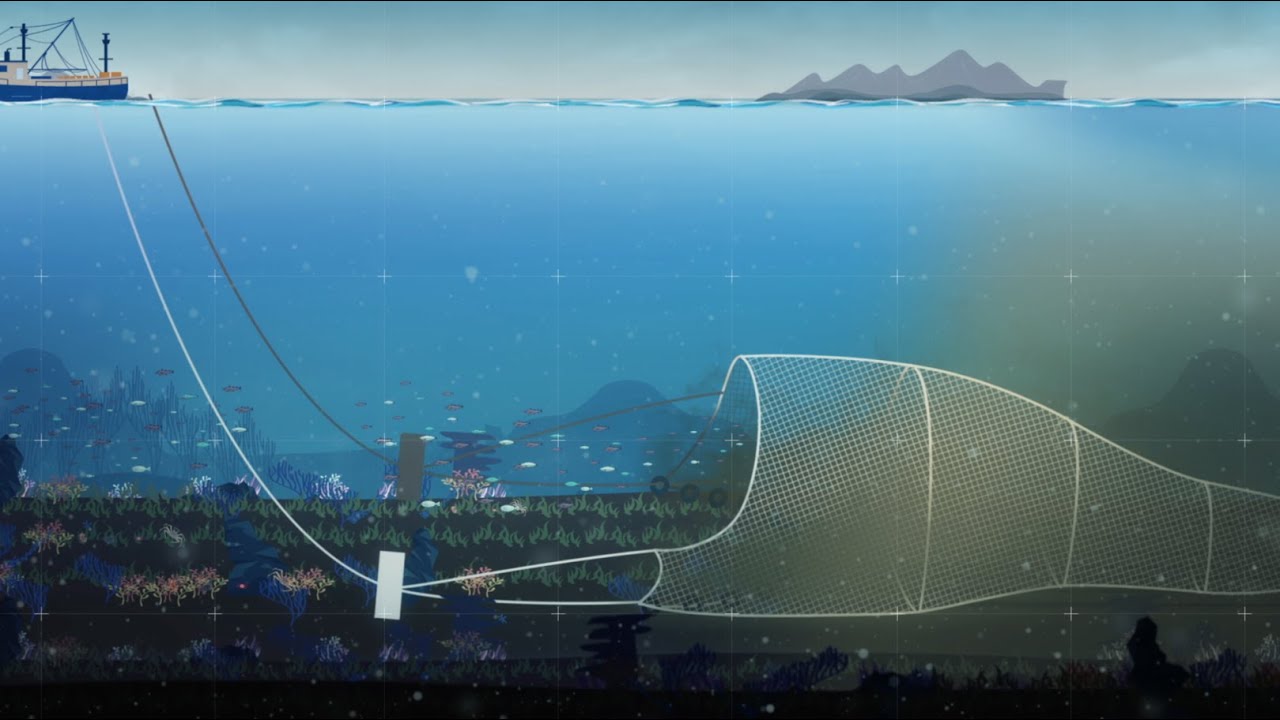 Bottom trawling. Source: Greenpeace
Squid, as well as octopus and cuttlefish, are a breed of cephalopod, who are recognised to be highly complex and intelligent.
Gill nets
Gill nets stretch across 1.6 to 3.2 kilometres in length (1 to 2 miles) and are 10 to 50 feet high (3 to 15 metres). Gillnets are invisible to fish. Fish become trapped when they swim into the nets; when they try to escape, they become caught by their fins, gills and spines. This is an extremely traumatic experience for fish, who often injure themselves further as they try desperately to escape.
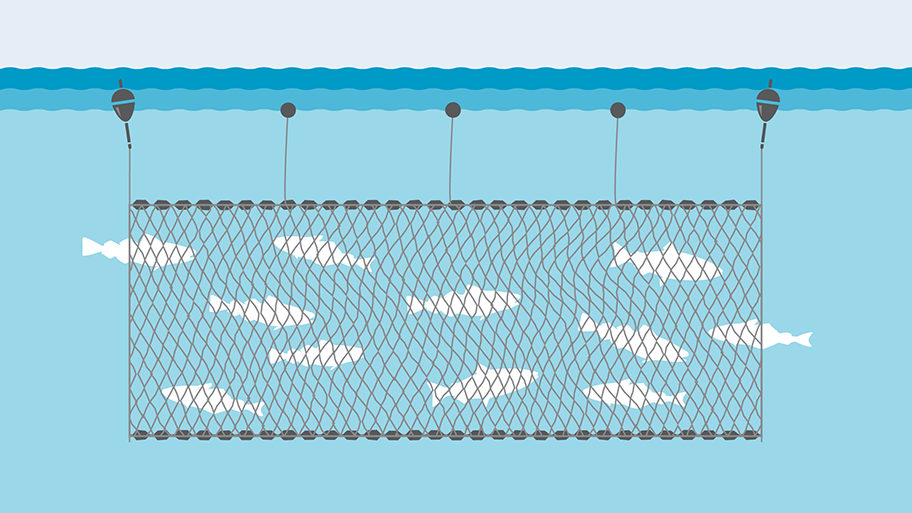 How gill nets work. Source: Marine Stewardship Council
Gill and trammel (a similar kind of) nets are the most commonly used fishing gear. These are used to catch gummy and saw sharks ('flake' fish) in Australia and many other nations around the world.
These nets are non-discriminate and consequently catch unintended species of sharks and other marine animals, known as by-catch.
Longlines
Longlines are used to catch a number of different species, depending on the depths in which they are placed. Swordfish, blue cod, gummy shark and tuna are all species that are targeted by this fishing method, as well as many others.
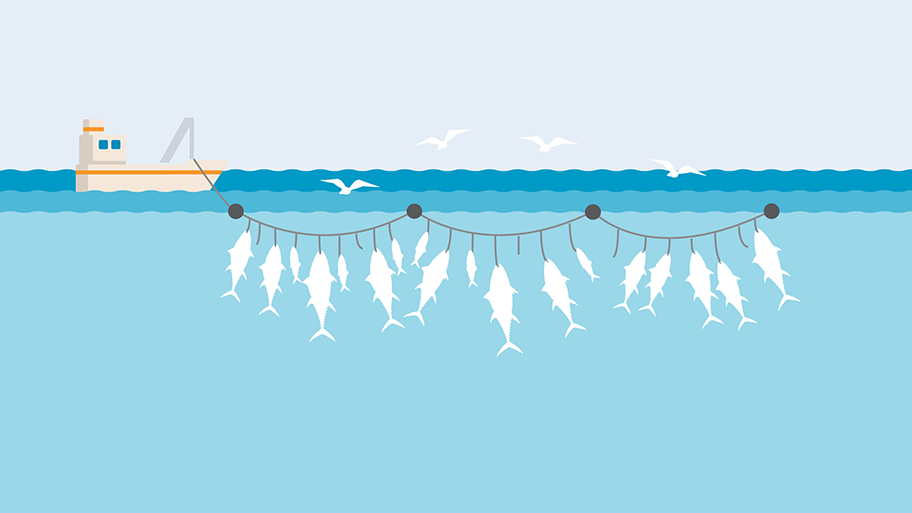
How longlines work. Source: Marine Stewardship Council
Longlines can stretch across 130kms with as many as 40,000 hooks attached to their length. They are left in the water for hours at a time before they are pulled back into boats, which means animals caught on the hooks may spend hours, stressed, trying desperately to escape.
Fish will be killed by either asphyxiation once they are pulled from their ocean home, or by bleeding out after being decapitated, sliced open or gutted.
Gaffing
In order to get larger fish onto the boat from a longline, they are impaled with a gaff hook. Put simply, they are stabbed whilst they are fully conscious.
Abandoned fishing gear - 'Ghost nets'
According to the Australian government: "Ghost nets are abandoned, lost, or otherwise discarded fishing gear in the marine environment, and are a global problem.
As ghost nets drift around the world, picked up by global currents and tides, they continue to indiscriminately 'fish', [trapping and killing] threatened and endangered species, and causing significant environmental damage."