Slaughter
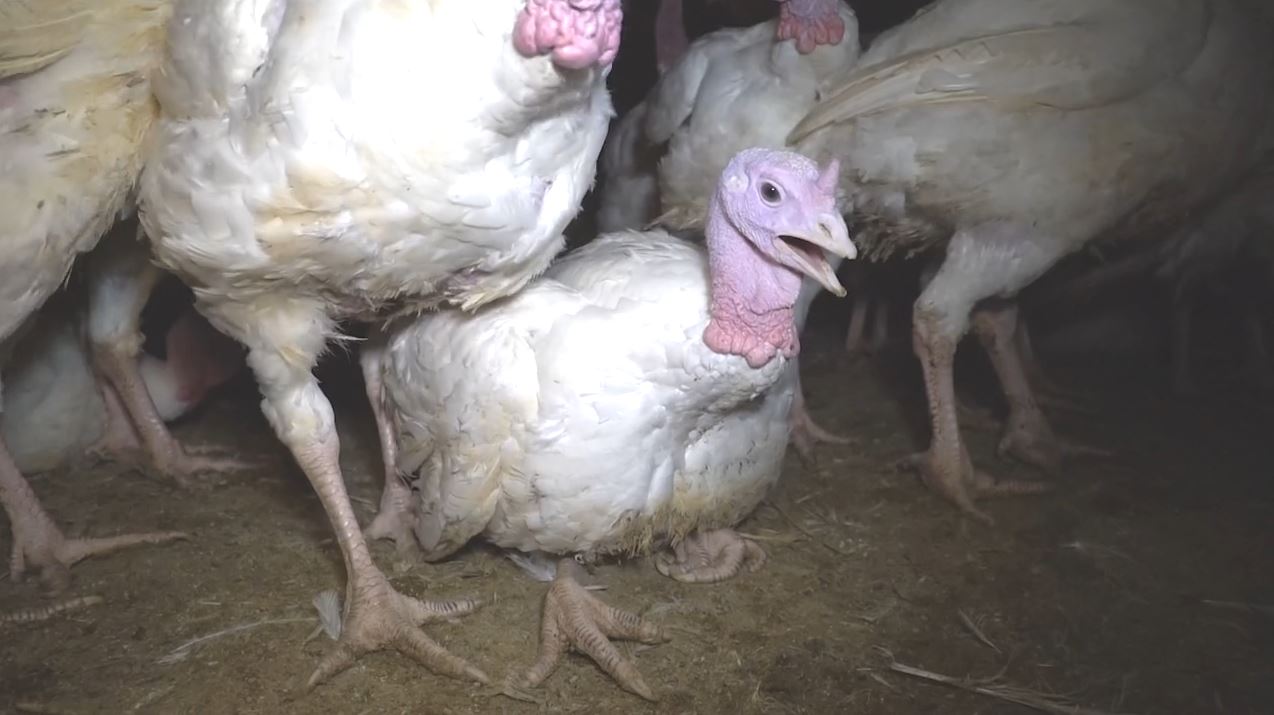
Hens are commonly sent to slaughter at 10 weeks of age, weighing around 5kg, their bodies primarily used for the 'whole bird' market. Toms are typically sent to slaughter at approximately 17 weeks of age, weighing between 16kg and 18kg, their bodies are mostly used for 'breast yield' and 'meat portions'.
The most common method of slaughter for turkeys in Australia is by electrical stunning and decapitation. Another common method is the use of bleeding cones.
Transport and rough handling
Several investigations have revealed the inherently rough nature in which turkeys are handled when being crated for slaughter. At the end of the growing period, workers walk factory-farmed birds to the edge of the shed then herd them up a loader (conveyor belt), where workers catch the birds and pack them into crates. Thirty-two centimetres (the length of a standard ruler) is the accepted minimum height of a crate in which large birds can be transported.(84) Turkeys are much taller than 32 cm and thus are forced to travel in extremely cramped conditions. Turkeys are commonly caught by their legs and carried upside down to be loaded into crates to be transported to slaughter.
Once the birds have been roughly and rapidly loaded into crates they are driven in a truck to the slaughterhouse. Whilst being transported, turkeys are prone to injuries such as severe bruising and bleeding, amputated toes, fractures, and suffocation (due to overcrowding), as well as to high stress levels.(85) Many turkeys die before they reach the slaughterhouse and there is an 'accepted' mortality rate during transport. For example, 'dead on arrivals' is a term commonly used to describe birds who die while being transported.(86) One study found that when turkeys were monitored in various modes of transport up to 4.2% had severe damage, which included death, amputated toes, large bruises and significant bleeding, while up to 13.3% had damage of some kind, such as bruising.(87)
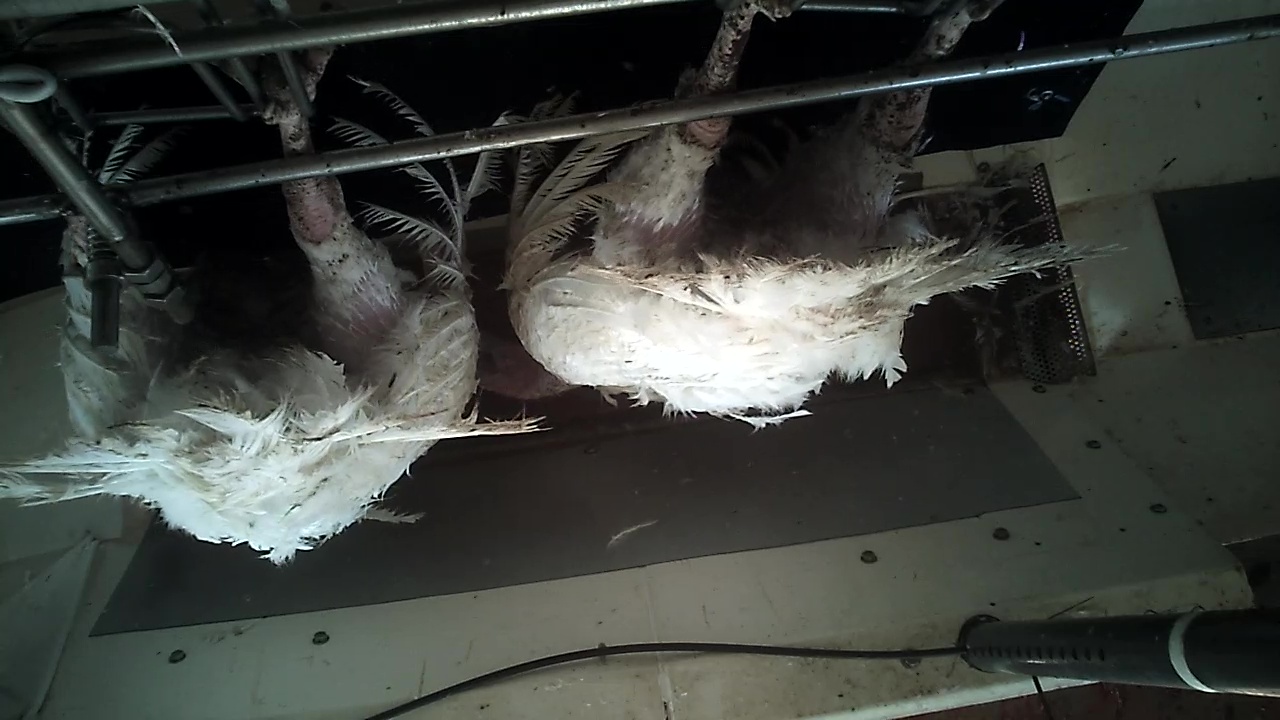
The same study found that 0.38% of birds died of acute and congestive heart failure, with death rates higher in summer, as many birds suffered from dehydration and metabolic problems.(88) After arriving at the slaughterhouse the birds are understandably tired, thirsty, hungry and stressed. Once inside the slaughterhouse, fully conscious birds are hung by their weak and crippled legs from metal shackles on a moving rail.(89)
Animal Liberation ACT (www.aussieturkeys.com)
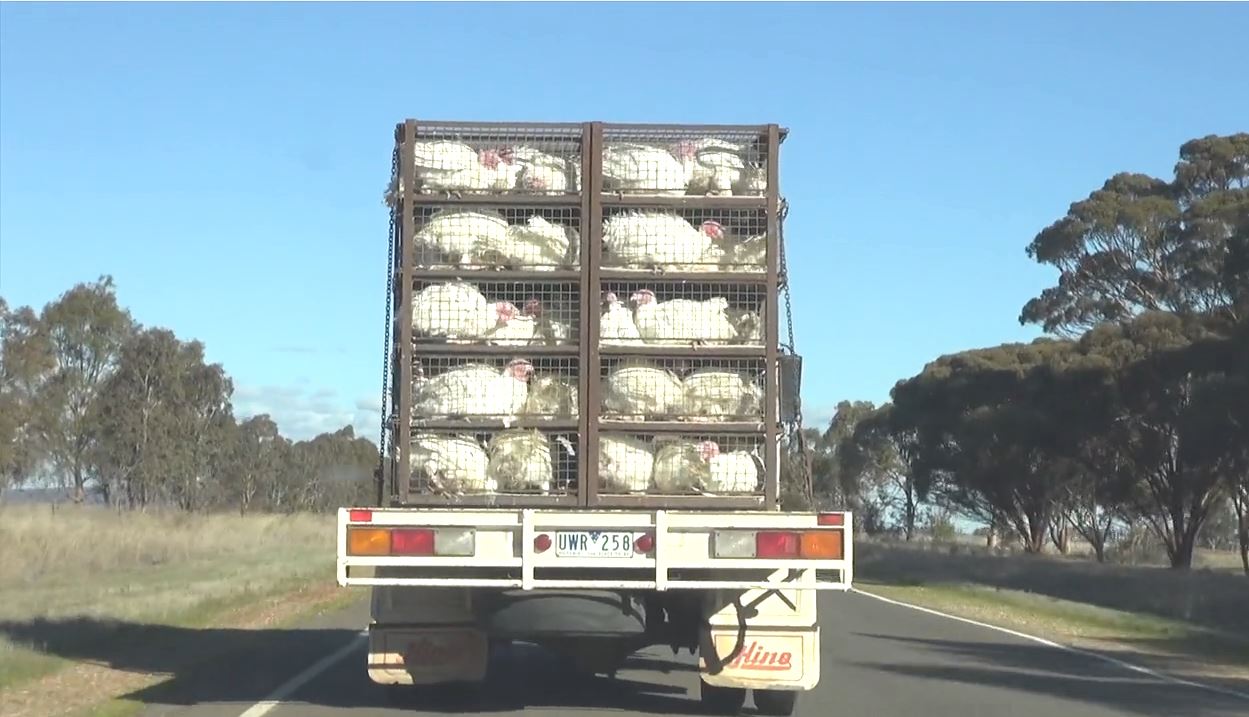
Many turkeys suffer broken or fractured bones during the loading/unloading process due to rough handling. Turkeys being transported from farm to slaughterhouse are exposed to extremities of weather.
Bleeding cones
Bleeding cones are a funnel-shaped apparatus in which turkeys are placed upside down, their head and neck exposed at the bottom, whilst the rest of their body is restrained in the cone. Turkeys are then decapitated and bled out in the cones. No stunning is required for this method of slaughter.
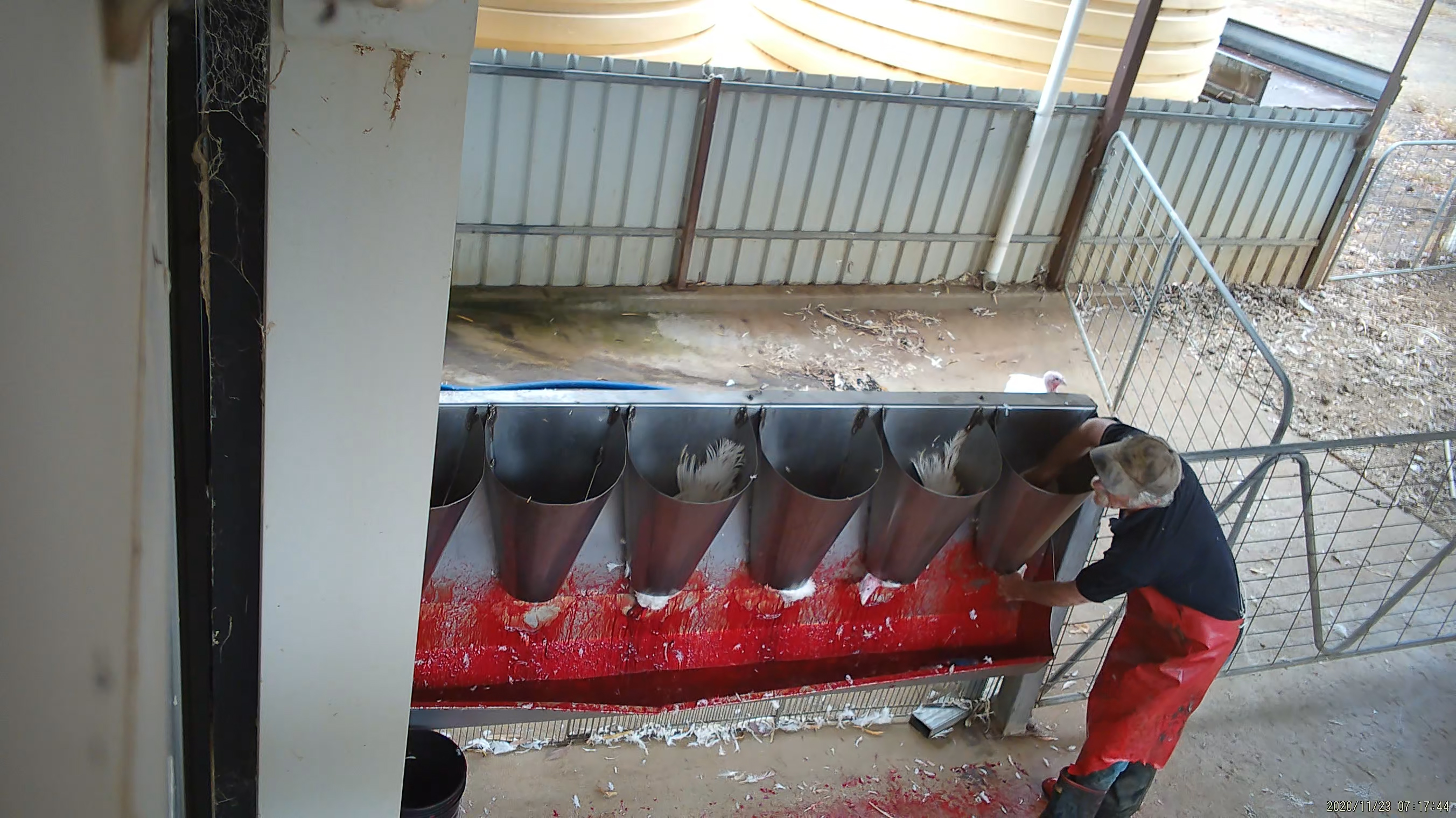
The European Food Safety Authority does not recommend decapitation as a form of 'stunning' as birds have been found to still be able to experience pain for up to 30 seconds after being decapitated.
Electrical Stunning
Electrical stunning involves turkeys being shackled upside down by their legs, their heads then pulled through an electrified body of water intended to render them unconscious before their throats are cut open or they are decapitated. Investigations have revealed poultry regularly lift their heads, missing the stun bath, and consequently are slaughtered whilst fully conscious.